
India vs China Urn Manufacturing: Which Sourcing Country Actually Wins?
If you're a funeral home, pet memorial brand, or Amazon/Shopify seller sourcing cremation urns, you've almost certainly weighed China against India. Both countries ship globally, both quote competitive FOB prices, and both can hit a container load. But the products they hand you back are not the same — and for a category as emotionally weighted as memorial products, that difference matters more than it does for almost any other home good. Here's what actually separates the two, based on what we see building urns out of a wood and metal workshop in New Delhi.
1. Material Sourcing: Solid Wood vs Engineered Substitutes
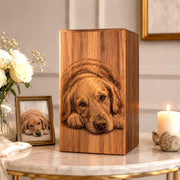
The single biggest divergence between Indian and Chinese urn manufacturing is raw material. India sits next to some of the world's best hardwood supply chains — rosewood (sheesham), teak, mango, and acacia are grown, milled, and worked within a few hundred kilometers of most manufacturing clusters. That proximity means Indian manufacturers can offer solid hardwood urns at price points that would be a specialty, upcharged item out of China.
Chinese urn manufacturing, by contrast, is built around its strengths: injection-molded resin, stamped metal, and engineered wood veneers over MDF cores. These are excellent for high-volume, low-cost decorative items, but they show their seams (literally) on a product where a buyer is often holding the item, running a hand across the grain, and making a values-based purchase decision rather than a purely functional one.
What this means for your catalog
- Premium and mid-tier SKUs favor India — solid wood and cast brass urns photograph and feel more expensive than their landed cost.
- Entry-level decorative SKUs (resin, painted composite) are often still cheaper out of China at very high volumes.
2. Craftsmanship: Hand-Finishing vs Mass Tooling
Most Indian urn workshops still rely on a hybrid model — CNC roughing followed by hand-sanding, hand-staining, and hand-fitted brass inlay work. It's slower, but it's also why you see engraved borders, filigree brass bands, and two-tone wood finishes coming out of Indian factories that would require expensive custom tooling in China.
China's manufacturing advantage is the inverse: once a mold or stamping die exists, it replicates a design at extremely low marginal cost and with tight dimensional tolerance. That's ideal for a single hero SKU ordered in huge volume. It's a poor fit for a brand that wants a wide catalog of finishes, sizes, and engraving variants without paying for a new tool every time.
3. MOQs and Flexibility for Smaller Brands
This is where the gap is largest in practice. Chinese factories are generally optimized around big-box and Amazon mega-seller volumes — MOQs of 500–1,000 units per SKU are common, and getting below that often means paying a steep per-unit premium or being turned away entirely. Indian workshops, especially export-focused ones working in wood and metal, are used to working with handicraft-style production runs and can typically support MOQs in the 50–200 unit range per design, which is a realistic starting point for a new Shopify or wholesale brand testing a SKU.
4. Quality Control and Defect Rates
Memorial products carry close to zero tolerance for visible defects — a chipped lid, a misaligned engraving plate, or a warped seam isn't just a return, it's a reputational risk in a category people research carefully before buying. Indian manufacturers exporting to the US and EU memorial market have generally built QC processes around 100% visual inspection per unit rather than statistical batch sampling, since run sizes are smaller and labor cost per inspection is low. Larger Chinese factories more commonly use AQL (Acceptable Quality Limit) sampling, which is efficient at scale but can let small cosmetic defects through on lower-volume custom orders where a dedicated inspection line isn't justified.
5. Lead Times and Logistics
| Factor | India | China |
|---|---|---|
| Typical production lead time | 25–40 days for wood/metal urns at moderate MOQ | 15–30 days, faster for repeat tooled SKUs |
| Main export ports | Nhava Sheva (JNPT), Mundra | Shenzhen, Ningbo, Shanghai |
| Ocean transit to US West Coast | ~30–38 days | ~16–22 days |
| Customs documentation complexity | Higher for wood (fumigation/ISPM-15 certs) | Lower for non-wood materials |
China still wins on raw transit time to the US, which matters if you're running a just-in-time inventory model. India's longer transit is offset by lower MOQ flexibility and, for wood products specifically, the fact that the wood is local rather than imported into the factory in the first place.
6. Landed Cost: The Number That Actually Matters
FOB price comparisons are misleading on their own. The number that determines your margin is landed cost: FOB price, plus freight, plus duty, plus any rework or defect-driven returns. Wood and brass urns from India often carry a slightly higher FOB price than a comparable resin urn from China, but a lower effective landed cost once you account for fewer cosmetic defects, lower MOQ-driven inventory carrying cost, and import duty treatment that's often more favorable for genuine hardwood products than for certain composite materials.
7. Compliance and Documentation
Wood urns exported from India require ISPM-15 fumigation certification on packaging, and a legitimate exporter will have IEC (Import Export Code), GST registration, and a clean Annexure IV / FEMA export-realization trail you can ask to see. Chinese exporters typically handle compliance through their trading company or factory's export license, with less wood-specific certification overhead since many products use non-wood materials. If you're vetting any manufacturer in either country, ask directly for: business registration, export license number, and — for wood products specifically — fumigation certificates per shipment.
So, Which Should You Choose?
Neither country is universally "better" — it depends on what you're building:
- Choose India if your brand is built around premium materials (solid hardwood, brass, marble), if you need flexible MOQs to test SKUs, or if your buyers care about craftsmanship and provenance as part of the purchase story.
- Choose China if you're selling a single decorative design at very high volume, your margin model depends on rock-bottom unit cost, and material authenticity isn't part of your brand positioning.
- Many established memorial brands do both — premium hardwood and metal lines from India, decorative/entry resin lines from China.
Sourcing Urns for Your Brand or Funeral Home?
SOULURNS is manufactured in-house by Qualcosa International (New Delhi) — solid rosewood, brass, and aluminium urns with wholesale MOQs starting at small case-pack quantities.
View Wholesale & B2B Pricing